Seeing Workforce Gaps Through a Different Lens

TalentSorter StaffEmployee Assessment Tools, Hiring Tips, Ideal Candidate Report, Onboarding

Workforce gaps

Have you ever heard the story of the truck stuck under a low bridge? And as the police and firemen and truckdriver battled over getting the cargo off and calling for a tow truck, a child watching the mayhem suggested letting some air out of the tires?

Sometimes the simplest solutions are right in front of us, yet we have trouble seeing them. We look at problems through the lens of the existing paradigms, the status quo.

The COVID crisis has caused many of us to change the way we do business.  Our market has changed. Our customers are buying differently – different product mixes, in different quantities, through different channels –  causing us all to re-think every aspect of our own business from how we procure, how we market, what we sell, how and to whom; even how we structure the business to deliver what’s required now, more efficiently.

And our people need to have changed too. Curbside pick-up and online orders are exploding.  The healthcare sector is overwhelmed, and the hospitality industry has the highest unemployment rate in several decades. How can we change our perspective on how to manage the workforce gaps?

How Do We Get the Truck Unstuck?

Perhaps there are tasks, not jobs, in healthcare that non-healthcare workers can do. Perhaps there are functions at the assisted living homes that family of residents and others in the community can do instead of internal staff. We know of an organization who did just that – they split off job tasks that were not interacting with residents and enlisted those from outside the industry to take them on. And it worked! Not only did it put people back to work who needed a job, it took some of the pressure off the exhausted personal care providers.

The pandemic caused us to think outside the box for recruitment of support staff in our assisted living facilities. We needed to grow our workforce yet our regular candidate pool had been maxed out. We realized that there were parallel roles in the tourism and hospitality industries where not only did the workers know what to do in laundry, kitchen, custodial, etc. roles but they would also have the right behavioural traits for interacting with our residents. We adapted our recruitment parameters using TalentSorter recruitment software to identify these candidates, and we were able to fill our vacancies quickly.

-Steven Doiron, Administrator, Inverary Manor

So let’s change the lens, and work out new paradigms to get us re-aligned for future success. Let’s look beyond the truck and the bridge – let’s look at the tires.


Still trying to figure what defines ideal people for positions in your company? Contact us – we’ve got some great tools to help you place the right people in the right roles.
The Theory of Job Fit

TalentSorter StaffEmployee Assessment Tools, Hiring for Fit, Hiring Tips, HR Technology, Ideal Candidate Report, Recruitment Tools, Uncategorized

Hiring for job fit

Most behavioural assessments are built on the Big Five model, which is an established model of behavioral psychology that has been relied upon as a predictor of occupational success. 

A few years ago, the Harvard Business Review backed this up with some interesting outcomes in their article “The Problem with Using Personality Tests for Hiring” in 2014.

Harvard Business Review Study:

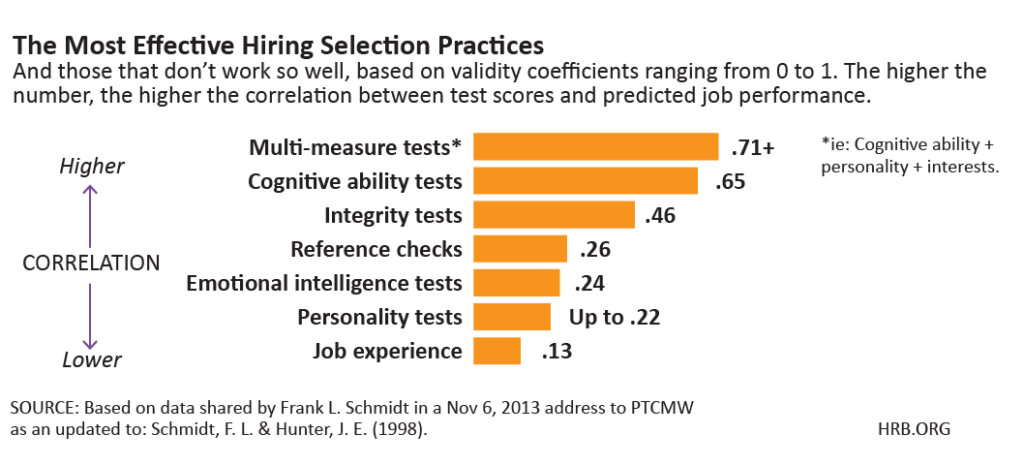
“Extensive research has been done on the ability of various hiring methods and measures to actually predict job performance. A seminal work in this area is Frank Schmidt’s meta-analysis of a century’s worth of workplace productivity data, first published in 1998 and recently updated. The table below shows the predictive validity of some commonly used selection practices, sorted from most effective to least effective, according to his latest analysis that was shared at the Personnel Testing Counsel Metropolitan Washington chapter meeting this past November.

So if your hiring process relies primarily on interviews, reference checks, and personality tests, you are choosing to use a process that is significantly less effective than it could be if more effective measures were incorporated.”

So, the importance of establishing job fit was once again underscored by the Harvard Business Review when they conducted a study on 360,000 individuals over a 20-year period. There were some startling discoveries that challenge the current recruitment practices of most organizations, proving that experience and educational qualifications are not statistically reliable predictors of future high performance in a role.

Further outcomes from the Harvard Business Review:

“Experience is usually a principal criterion for making hiring decisions… Yet we found little difference in performance between these experienced individuals and those with no experience. The person with no experience, given training and supervision, is as likely to succeed as the person with two or more years of experience.

There is an old saying that 20 years’ experience reflects one year’s bad experience repeated 20 times. Our findings confirm that this is often the case. Too many people cling tenaciously to their unsuitable jobs and do just well enough not to be fired. Thus they accumulate years of “experience”.

As a value to be cherished and encouraged in our society, education cannot be challenged. The use of formal degrees as the criterion for judging someone’s potential effectiveness in a …job, however, must be challenged….The results of our probing show that people with little education can do the job as effectively and as readily as those with college degrees.

In view of these findings, an obvious question arises: If these long-used criteria are invalid, what criteria can industry use to better predict job performance? The answer is: criteria that make a better match between the person and the job.”

So how do you establish good ‘job fit’?

Identify and quantify the critical success attributes of a role, such as:

  • Mental demands.
  • The work environment.
  • Core behavioral traits most needed for the role (eg, assertiveness, creativity, etc).
  • Occupational interests.

Once this is established for each position in a company and used as a basis for hiring, employers are able to drastically increase the success rate of spotting and hiring high performers for each role.

Interested in learning more about ‘job fit’ profile reports and how they can help speed up your hiring process?

Navigating the Employment Assessment Marketplace

TalentSorter StaffEmployee Assessment Tools, Engagement, Hiring for Fit, Hiring Tips, HR Technology, Ideal Candidate Report

Assessments for hiring and retention

Finding the RIGHT person for your business has never been more challenging. Over-reliance on the resume as a proxy for what someone brings to the table is risky. Where someone went to school, what they chose to study, how far they got, and what jobs they have held until now tell you nothing about who they are as an individual, what they are capable of and what their true potential is, and what they will add to your team or organization.

We know from experience that when people are matched with roles on the basis of their fundamental compatibility with the essence of the job itself, magic happens. Work suddenly gets done faster, better and with less effort.

When a person ‘fits’ with their manager, the job, the people they work with, and the organization, it builds energy, trust and connection. They can relax into being themselves, not pretending to be someone else. They can invest in the relationships that lead to great work. 

Understanding the Marketplace

The term ‘assessments’ is used loosely today, to describe a wide array of instruments and products, that range from simple to complex:

Skills tests – designed to measure someone’s knowledge, accuracy or proficiency at a specific task. Generally speaking, these are things that can be learned… so an employer might decide they want to screen applicants for a clerical position, for their proficiency in Excel, or a programmer candidate for their coding skill, or a warehouse applicant for picking accuracy. Some employers will use these as a pass/fail; we recommend instead that if they are confident they have found a candidate who is a strong fit for the job and there’s a (manageable) gap in knowledge that could be addressed with a little training, that training is generally a really good investment.

Simulations – these are generally online tests where real-life situations and challenges are presented to candidates, as a way to see how they perform. An example would be a Customer Service candidate receiving realistic but simulated calls from customers and needing to manage the interactions to successful conclusions. As with skills tests, they may be used as pass-fail or as a training ‘gap analysis’. 

Interests, values, and other questionnaires – these are designed to measure different aspects of a person’s attitudes and preferences. The data may be useful to the new manager in understanding how best to establish rapport and motivate the new employee.

Job Previews – these are often set up as ‘day in the life’ exercises where a shortlisted candidate is invited to spend a part or full day partnered with a ‘buddy’ in the role. This gives both the company and the individual a low-risk ‘test drive’ before an offer is signed.

Communication/Style preference tests – these come in many forms and many are easily recognized brands including Profiles Performance Indicator, DiSC, Myers-Briggs, True Colors, TTI, Predictive Index and others. These instruments are useful for understanding someone’s preferences – how they prefer to communicate with and interact with others. Results are often presented in a four-quadrant model and they are generally most useful to understand and improve team dynamics.  These tools are NOT designed to be predictive of occupational success and they are sometimes misused.  

Cognitive tests – can be used to measure problem solving, logic, and reasoning skills, and the ability to ‘think on one’s feet’ and deal with ambiguity. May be more relevant in relation to certain roles than others, and the results can be one reliable indication of ‘fit’.

Psychometric/behavioral assessments – are designed to measure someone’s ‘core’ behavioral traits; ‘who’ they are deep down, and how they naturally interact with the world including their standards, attitudes and behaviors that would be observable by others. These instruments are reliable predictors of job ‘fit’ and can be used very effectively in the applicant screening process.

360-degree review and other feedback instruments – are designed specifically for the purpose of collecting and presenting feedback from peers and others in a framework that deepens self-awareness and presents an opportunity for growth and leadership development.Each is well suited to a specific application, and like any tool should only be used for the application for which it was designed. In the same way as you’d never use a hammer to turn a screw, you’d never want to use a skills test or 4-quadrant personality style questionnaire to predict someone’s likelihood of fit in a specific role – you’d be getting perfectly good information, but for an application it was never designed for, and for which it may not be valid. 

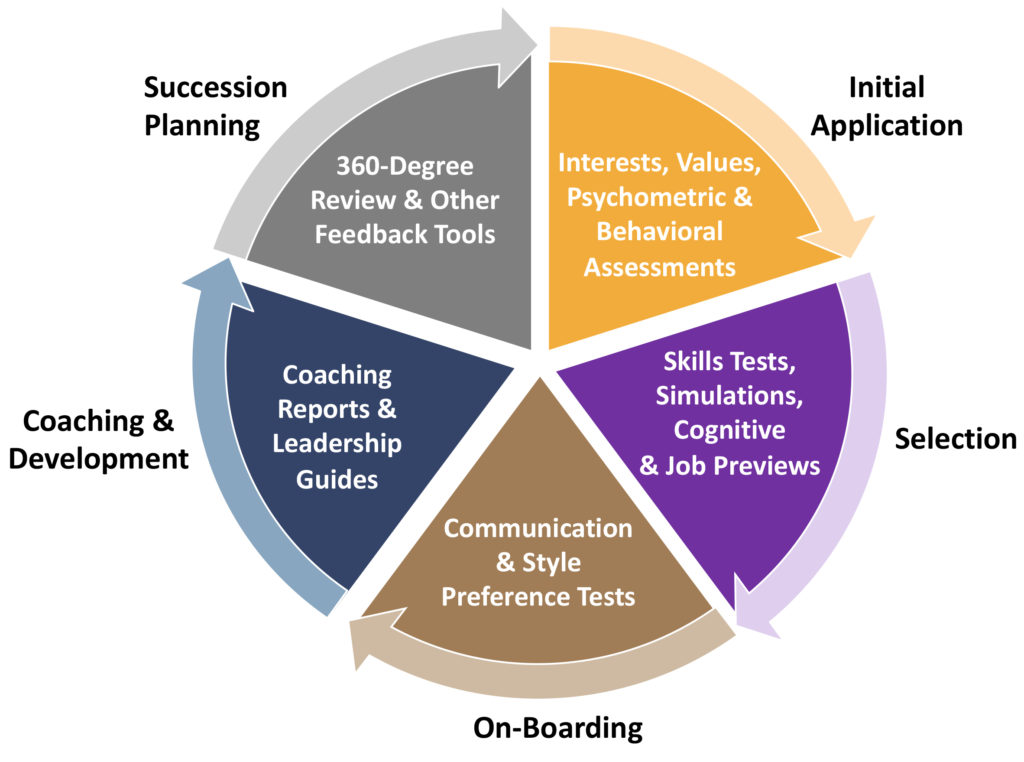
Assessments in the Context of the Lifecycle of an Employee

Different assessment tools help support different stages in the lifecycle of an employee from when they’ve been hired to when they retire.

Assessment tools vary at different stages in the lifecycle of an employee.
  • The first stage is the initial assessment and selection of a potential employee – this is where behavioural assessments are used most effectively.
  • Behavioural assessments are also useful after an individual has been hired. Coaching reports and leadership guides help support the on boarding as well as the ongoing coaching and development. 
  • Certain products can also be very effective when looking to do succession planning, or restructuring. You can easily ‘project’ an individual to any other position in your organization chart of jobs.

Interested in learning more about assessment tools?

Contact Us

Managing a Productive Remote Workforce

TalentSorter StaffEmployee Assessment Tools, Employee Interaction, Engagement

Shows a remote worker during covid

With growing measures to stop the spread of COVID-19 (Coronavirus), a large number companies across the globe have had to suddenly tell their employees to work from home. 

For many employees, this is something they’re happy to embrace – once they’re setup with the right tools, they will stay productive and continue with business as usual from a home office environment.

However, for some, the directive to work from home can spell disaster if management doesn’t fully recognize what’s required to help those individuals continue to thrive in a changing, more isolated environment. 

Easing the Transition:

So, with no choice in the matter, how do we make this prompt transition to a home office as smooth as possible for everyone, regardless of their workplace preferences or personality? 

First, ensure you’ve addressed any technical roadblocks by outlining a clear list of what is needed for each individual to get setup at home. Help fill in any hardware gaps, such as:

  • Loan of a laptop or desktop screens
  • A comfortable office chair
  • Desk phone and headset
  • Some extra printer cartridges

As well, make sure everyone is comfortable with remote file sharing on such platforms as:

  • Google Drive
  • Dropbox
  • MS OneDrive
  • OneHub

Next, help employees understand working hours and scheduling requirements whilst away from the daily office structure. Assist them with creating a sharable task schedule or tracking system, using such tools as:

  • Trello
  • Monday
  • SmartSheet
  • Jira
  • Toggl

Also, suggest that they build their own ‘Family Schedule’ with the other family members who are stuck in the house. This will minimize distractions and anxiety as everyone in the household has established guidelines and boundaries during work hours. 

Stay Connected:

Once everyone is set up remotely, keep in mind that there is only so much you can communicate through text and group emails. Overtime, not working with people face to face can sometimes make it difficult to guide them or fully gauge their emotions, intentions and well-being – especially at this time when we are all dealing with a lot of change and unknowns in our daily lives.

When in a standard office environment, studies show that many employees rely on the morning team meeting to gain positive energy and feedback from the others in order to get their day started. And, during breaktime, workers often look forward to the social aspect of pouring a cup of coffee and engaging in spontaneous chatter about news, sports, or movies.

So, if you haven’t already, start by implementing an efficient messaging app (such as Slack) to make back and forth online discussion much faster and easier. But don’t stop there. Get your remote team in the habit of replacing some of those messages and emails with phone calls instead, even doing some of your calls via FaceTime. And for your team discussions, maintain a cohesive group feel by doing video meetings using Skype or Zoom on a regular basis – seeing faces and sharing screens can go a long way towards morale and productivity.

Extra Tools to Help You Manage:

With the long-term outcome of this pandemic still very much unknown, people may have to continue working remotely for quite some time. As this plays out, business owners and managers need to feel confident that they can maintain a motivated, engaged workforce from afar. 

Consider tools such as the PXT Select suite of behavioural, engagement or leadership assessments to help you continue the alignment and understanding of your team’s strengths, weaknesses, and abilities – giving you more power to coach and develop your people to their full potential during this unprecedented time in the workplace.

Reassurance:

No matter what, make sure your team knows that you’ve got their back. ‘Social distancing’ does not mean anyone will be sent home and forgotten about – everyone should feel trusted, valued and looked after for as long as they’re working remotely and beyond.

Want to discuss more about this topic?

Get in touch to share your thoughts and discuss more options to help keep your staff engaged:
info@fitfirsttech.com
1-800-513-7277